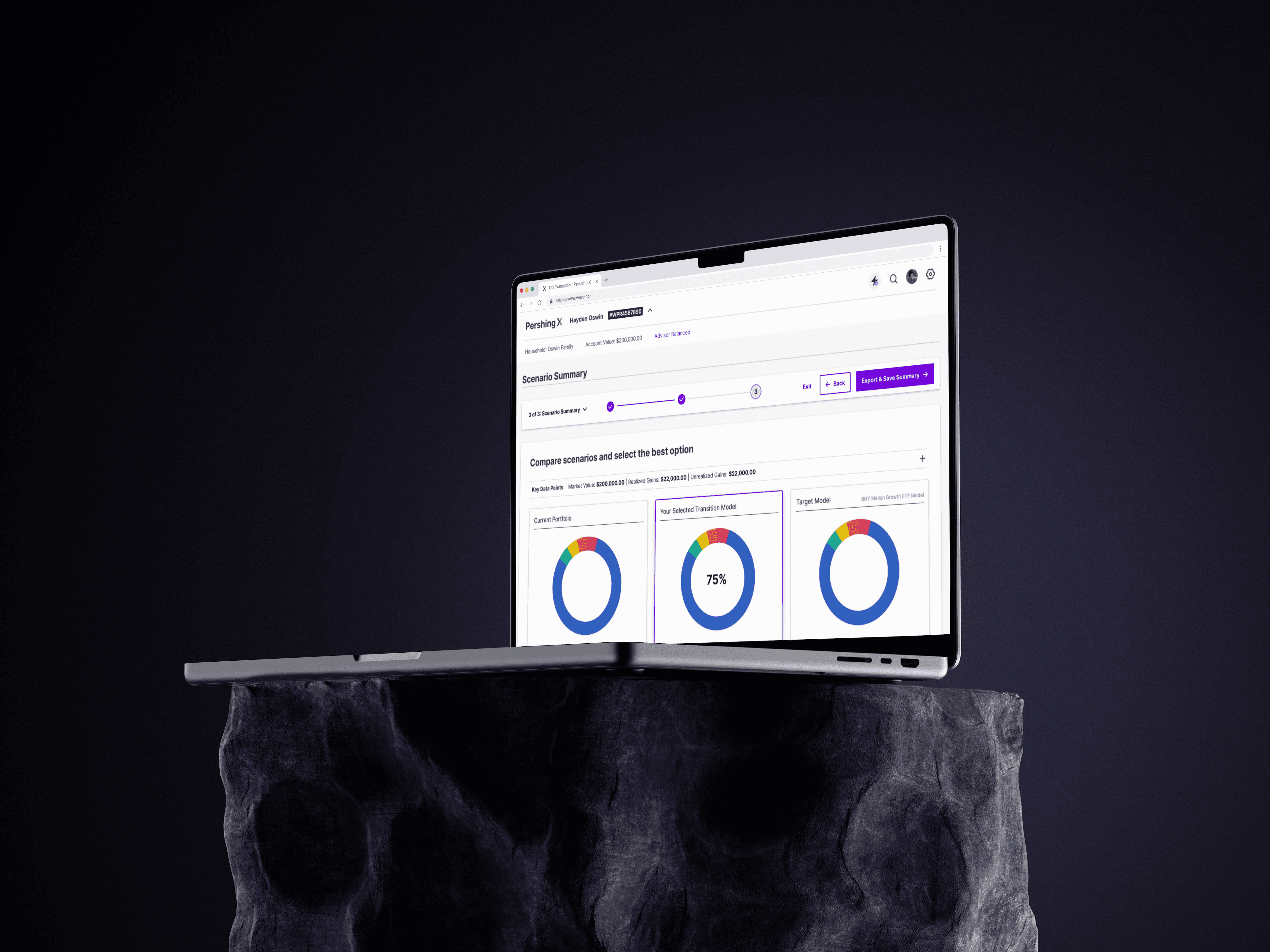
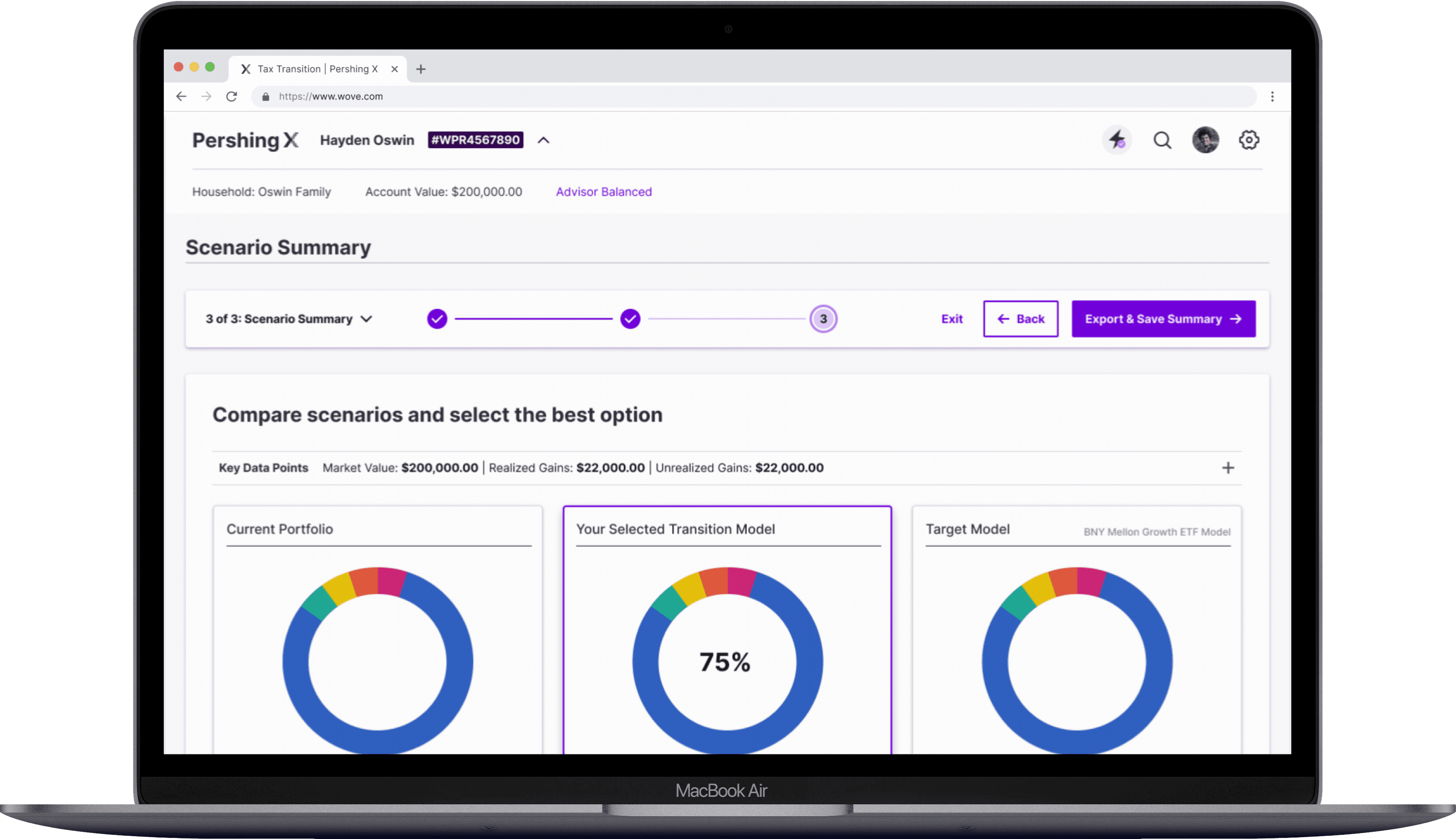
Tax Transition is a web application within the Pershing X ecosystem that helps financial advisors evaluate and optimize the tax impact of moving a client from one portfolio model to another.
//Role
Senior UX Designer
//Duration
April 2022 to April 2023, Ongoing
//Context
BNY Mellon through Publicis Sapient for Pershing X (now Wove)
//Industry
Fintech / Wealth Management
I worked on the product as a Senior UX Designer, helping shape the experience through discovery, flows, wireframes, prototyping, usability testing, and iterative design decisions across the Day 2 release.
Problem & Opportunity
The Problem
Investors are often hesitant to change portfolios because unrealized gains can create meaningful tax consequences. Advisors need to help clients get closer to a target portfolio without creating more tax burden than the client is willing to accept.
This is also not always an all-or-nothing decision. Clients may want to keep certain holdings or stay within a specific tax budget, which makes the process more complex than a simple portfolio swap.
The Opportunity
There was an opportunity to create a cleaner, more supportive workflow that would help advisors:
compare a current portfolio against potential target models
understand tradeoffs at different tax budget levels
review recommended trades
generate clearer client-ready reports
The product’s value came from making a technical process easier to understand, easier to explain, and more flexible to each client’s needs.
Goals & Success Criteria
Help advisors propose and optimize tax-smart portfolio transitions
Make client impact easier to understand
Support partial transitions across different tax budgets
Improve on workflows that often depend on Excel or outside support
Create a workflow that feels clear, guided, and trustworthy
Success depended on whether advisors found the tool more useful than what they use today, understood how to use it, and felt confident using it in client conversations.
Context & Constraints
Tax Transition was part of Pershing X, a connected suite of financial tools built for financial advisors. The Day 2 scope focused on high-priority UX recommendations that came out of earlier advisor research.
There were also real delivery constraints. During my first several months on the project, our UX lead was unexpectedly absent for about four months, so I had to take on broader responsibilities quickly, including presentations, coordination, and communication across teams.
We also had to make design decisions around loading behavior and sequence of information, which affected how the experience was structured. Later, once the development team aligned around Tailwind CSS, that framework also influenced implementation-ready design choices.
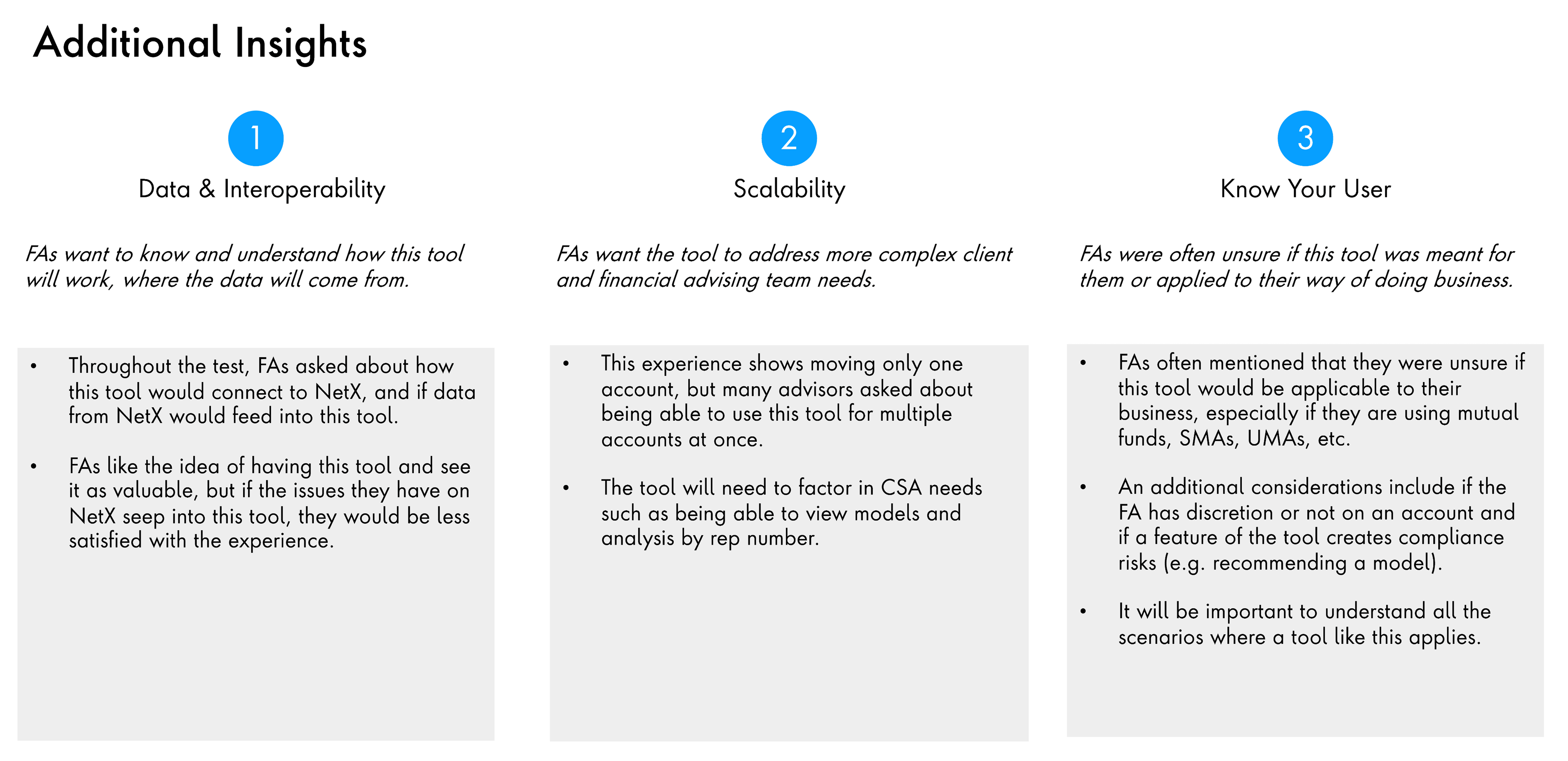
The MVP was intentionally limited in some areas, including support for only a single account, even though advisors made it clear the future experience would need to scale.

Users & Research
Target Users
Financial advisors using Pershing X to evaluate and explain tax-aware portfolio transitions for clients.
Research Approach
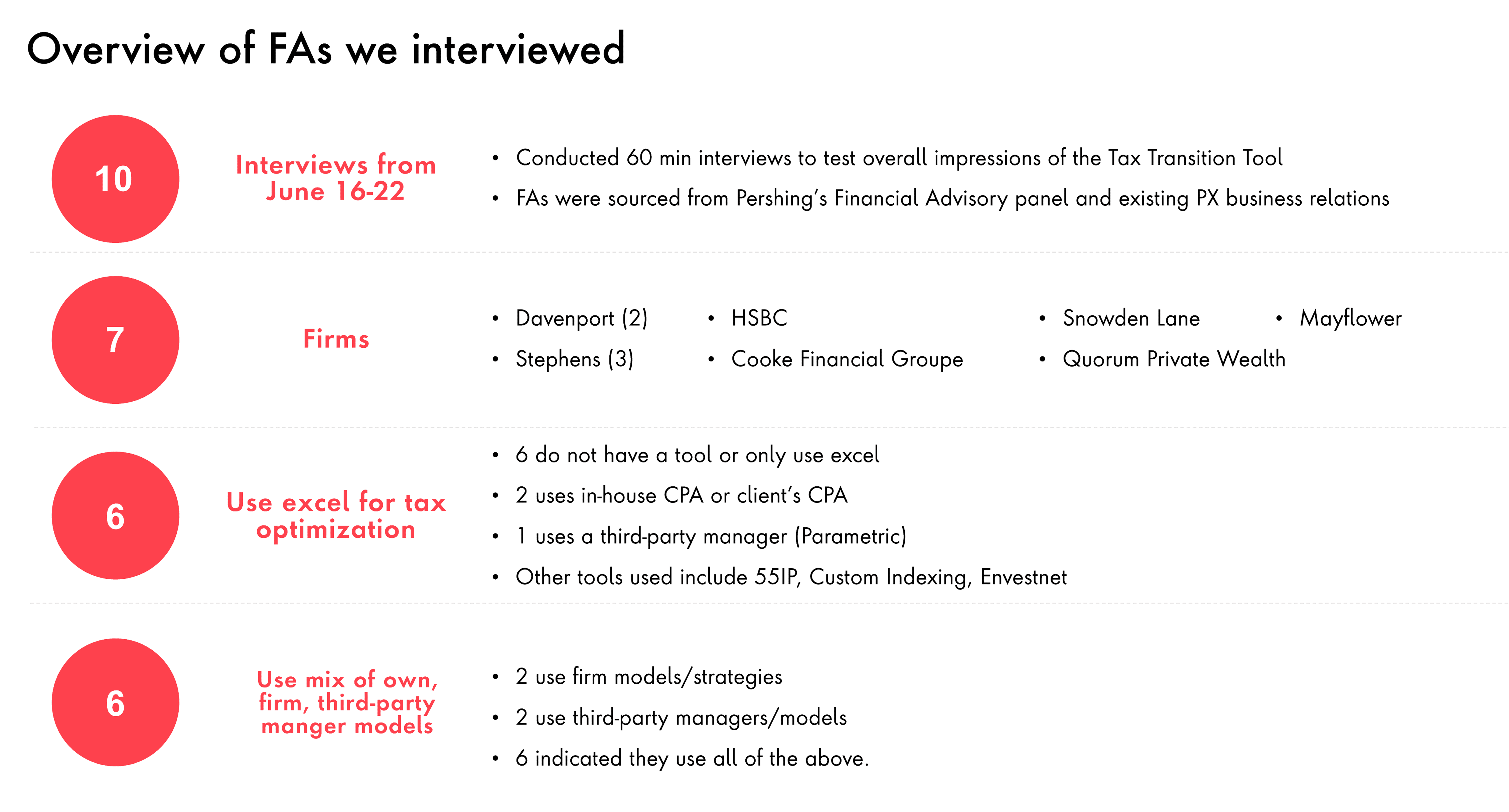
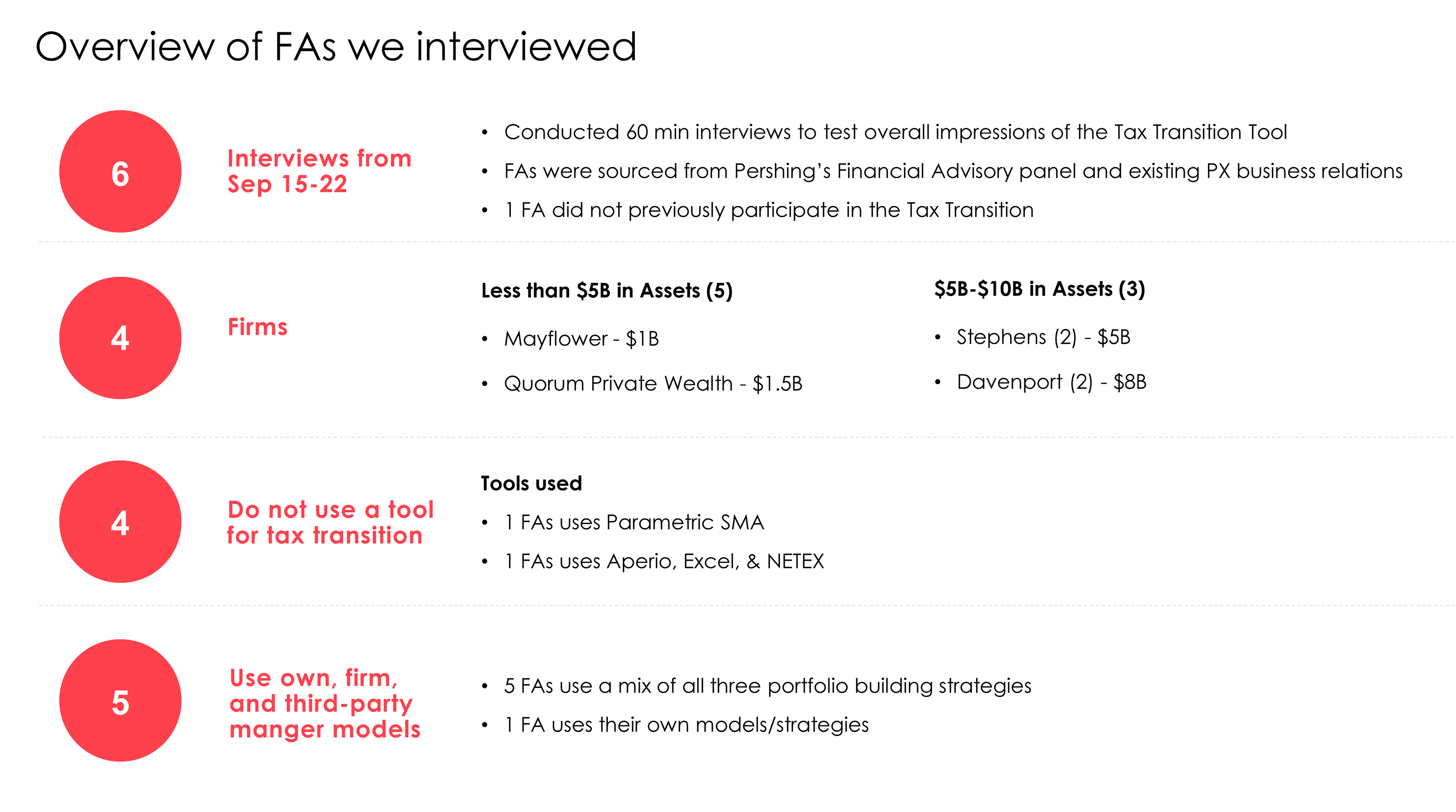
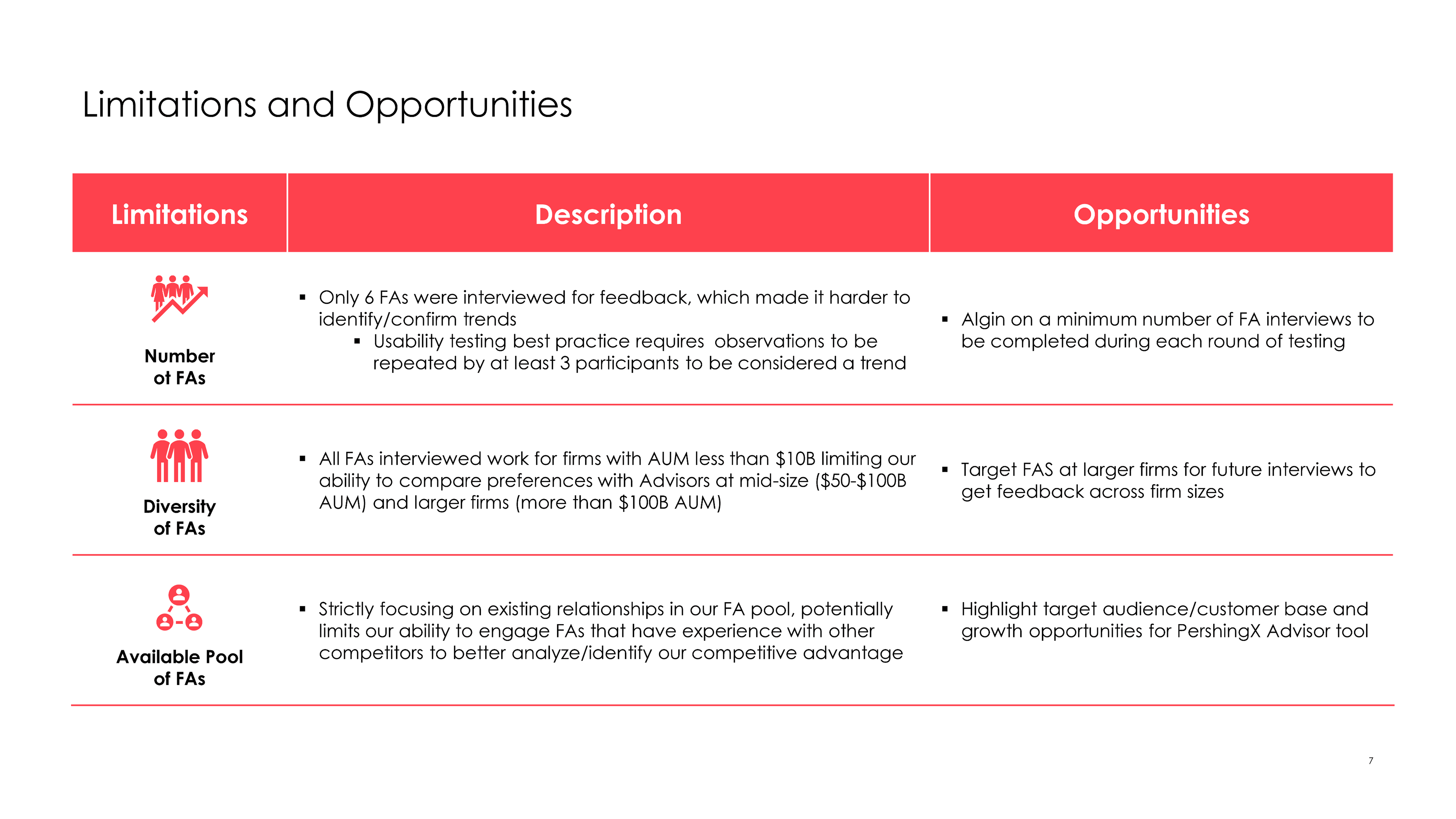
The work included discovery plus two rounds of usability testing.
Round 1
10 in-depth interviews
60-minute sessions
advisors walked through clickable wireframes
Round 2
6 in-depth interviews
60-minute sessions
advisors walked through an updated clickable prototype
The sessions focused on clarity, confusion points, perceived value, and how well the workflow fit real advisor needs.
Key Insights
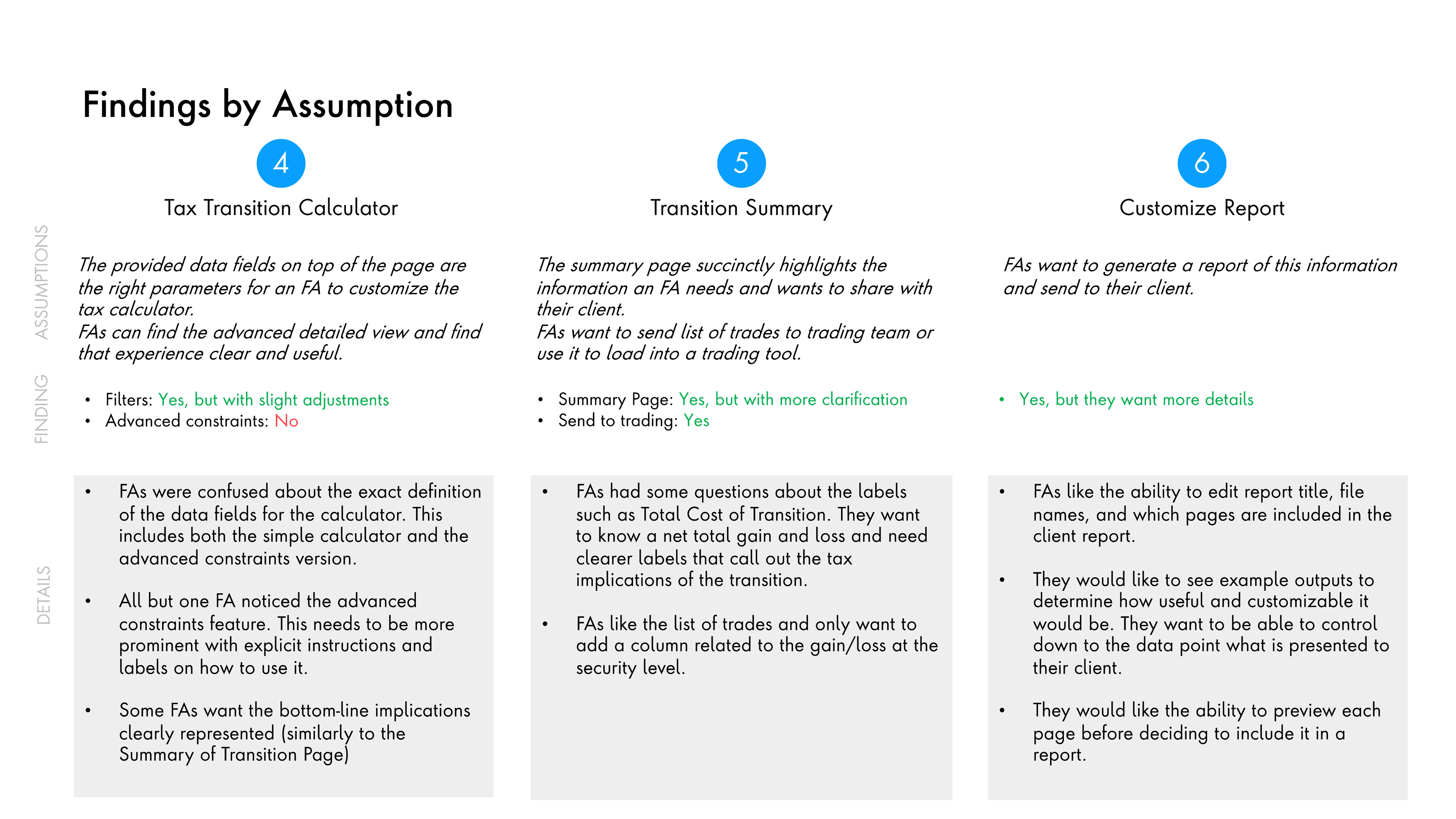
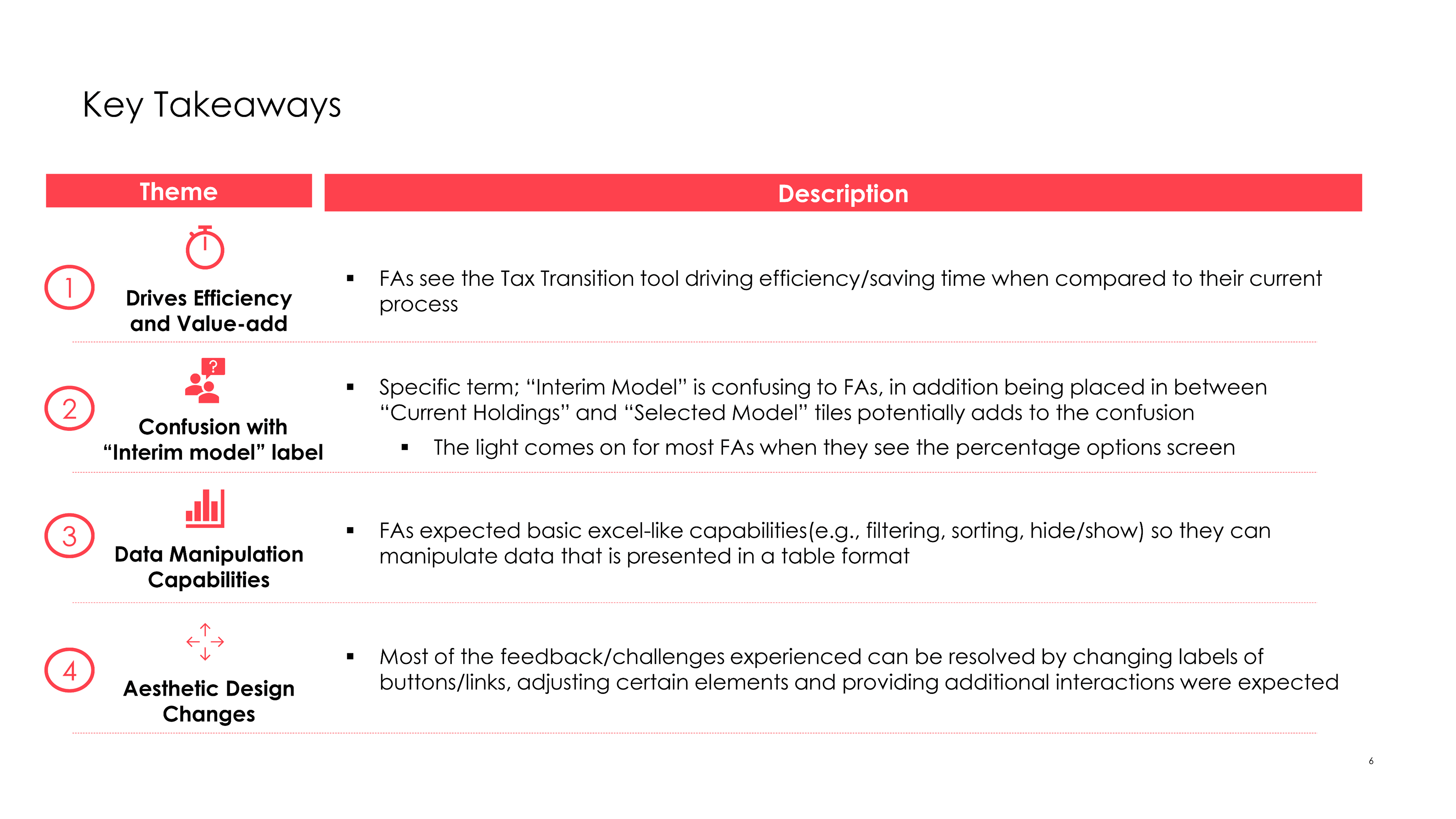
advisors saw the tool as a meaningful improvement over Excel-based workflows
the workflow felt unfamiliar, so guidance and terminology mattered a lot
copy was critical, especially around terms like “model” and “interim model”
advisors wanted more transparency around where the data came from and how it connected to the broader Pershing X ecosystem
the tool’s value depended heavily on interoperability, model access, and ecosystem support
most usability issues were clarity problems, not total workflow failures
Problem Statement
How might we help financial advisors propose and optimize taxes when changing from one model to another?

Strategy & Approach
The strategy started with discovery: reviewing similar tools, identifying opportunities for differentiation, consulting subject matter experts, and validating assumptions with financial advisors.
From there, the work focused on the highest-priority Day 2 UX recommendations. The design approach centered on making a complicated financial workflow feel more understandable through:
stronger guidance
clearer terminology
more explicit explanation of client impact
flexible tax budget options
better support for review and reporting
Information Architecture & Flows
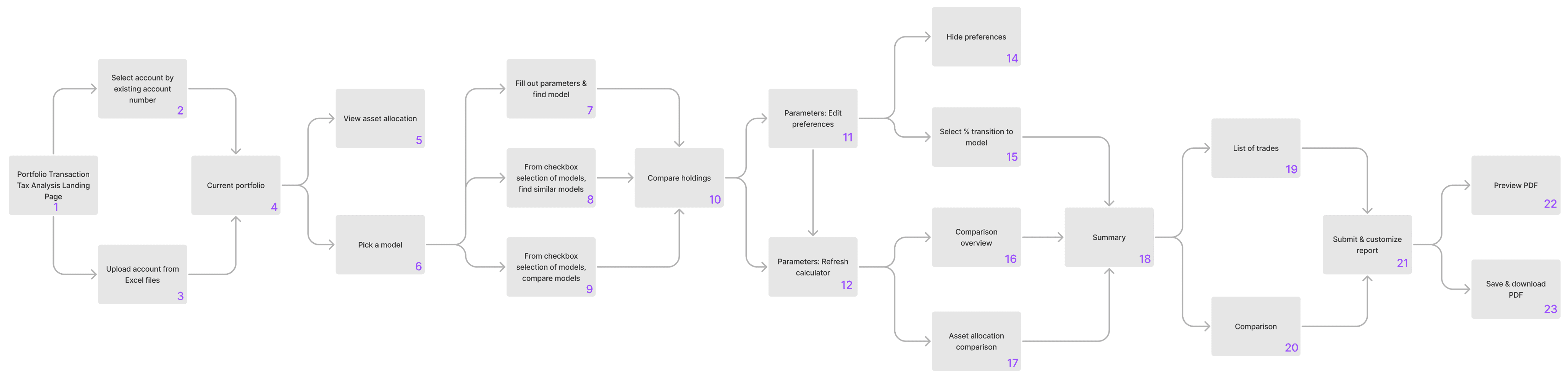
The flow guided advisors through a multi-step process that included:
selecting an account or uploading a file
reviewing current holdings
selecting a comparison model
exploring transition scenarios
adjusting a tax budget
reviewing trades and allocation changes
customizing a report for export
A major part of the structure was helping advisors move from intake to analysis to reporting without losing context.
Design System & Visual Direction
The visual direction followed the broader Pershing X style: clean, professional, structured, and highly legible in a data-heavy financial environment.
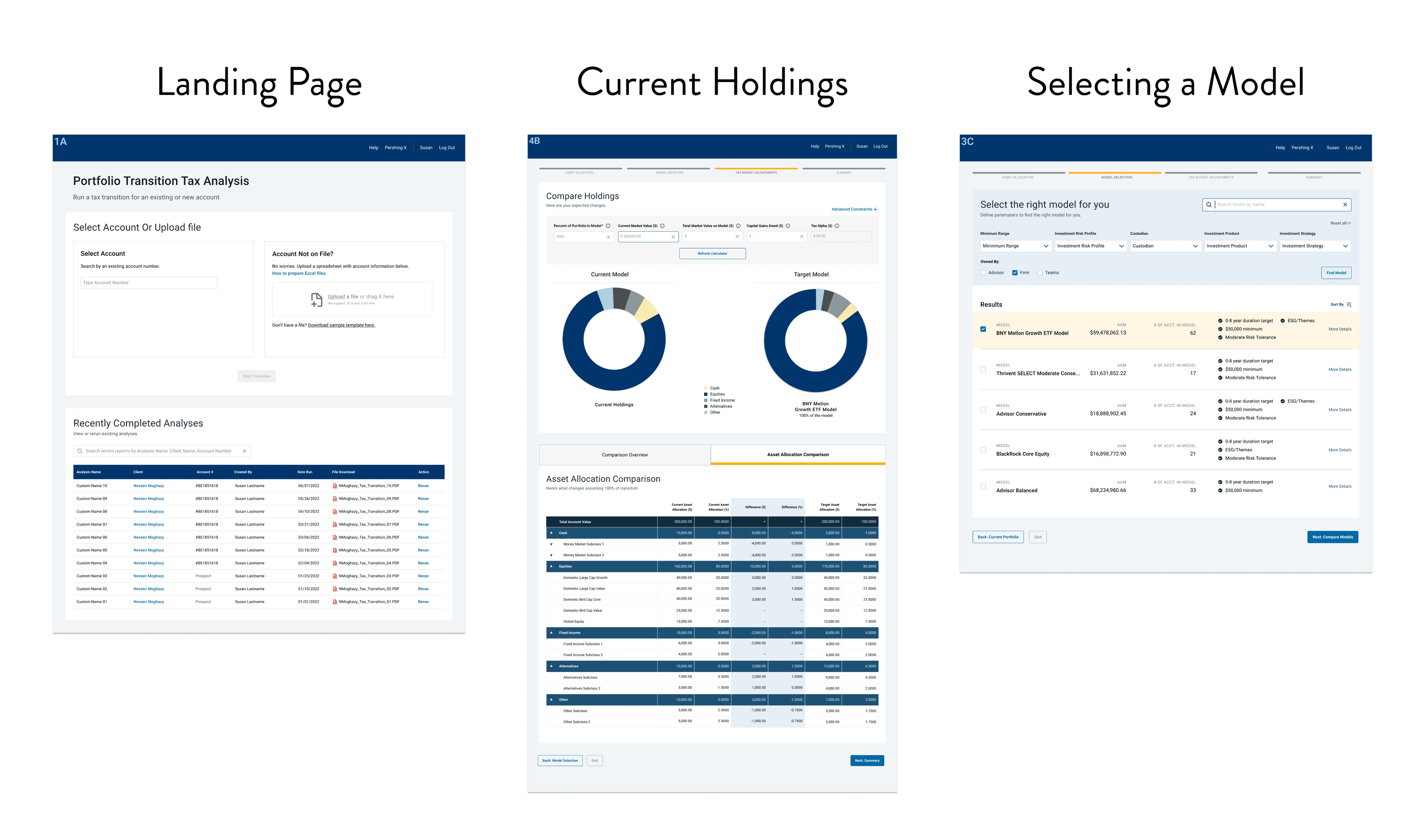
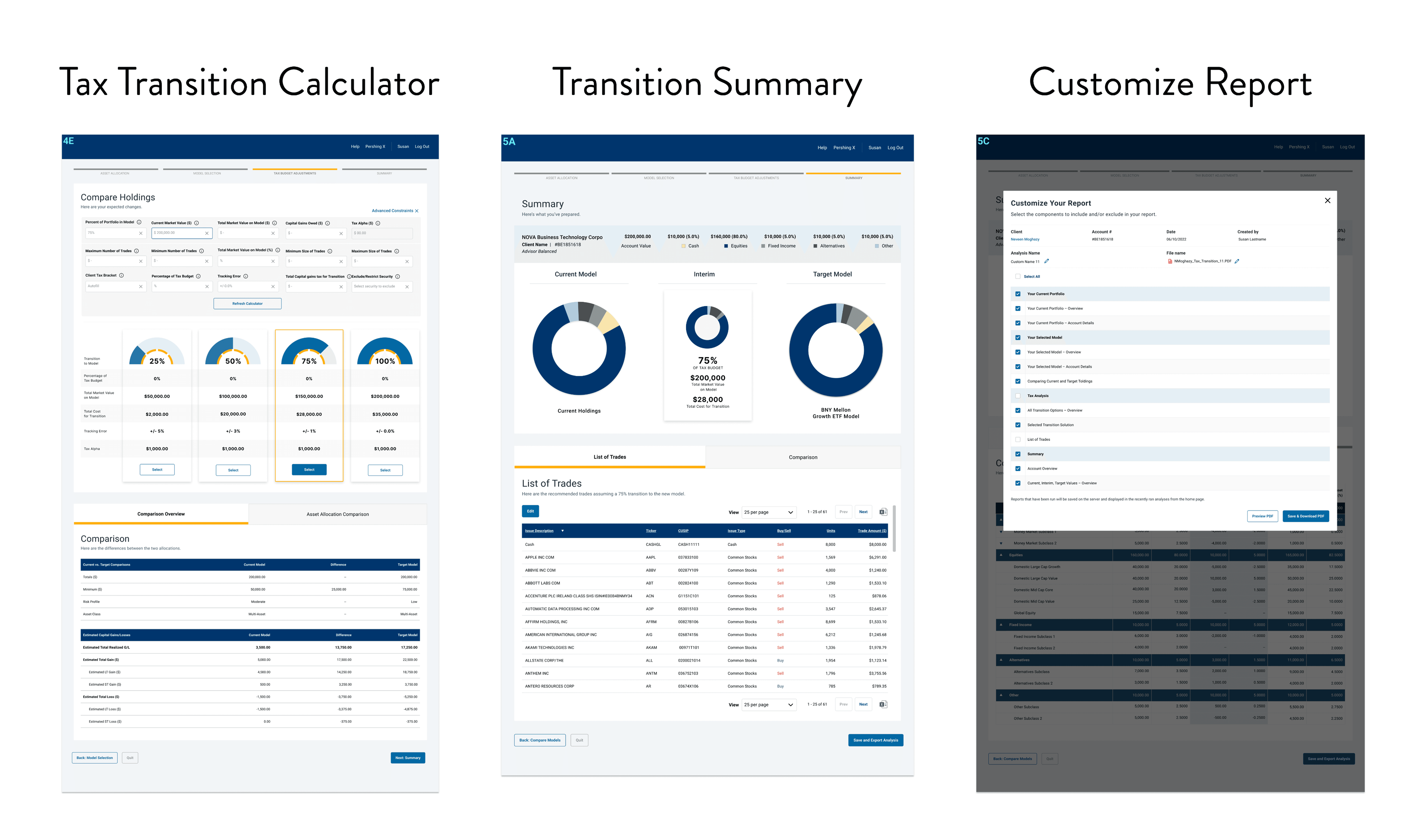
The interface used side-by-side comparisons, donut charts, summary cards, tables, and report customization tools to make complex information easier to interpret. A major priority was reducing cognitive load while still keeping enough detail for advisors to feel informed and confident.
Wireframes to Prototype

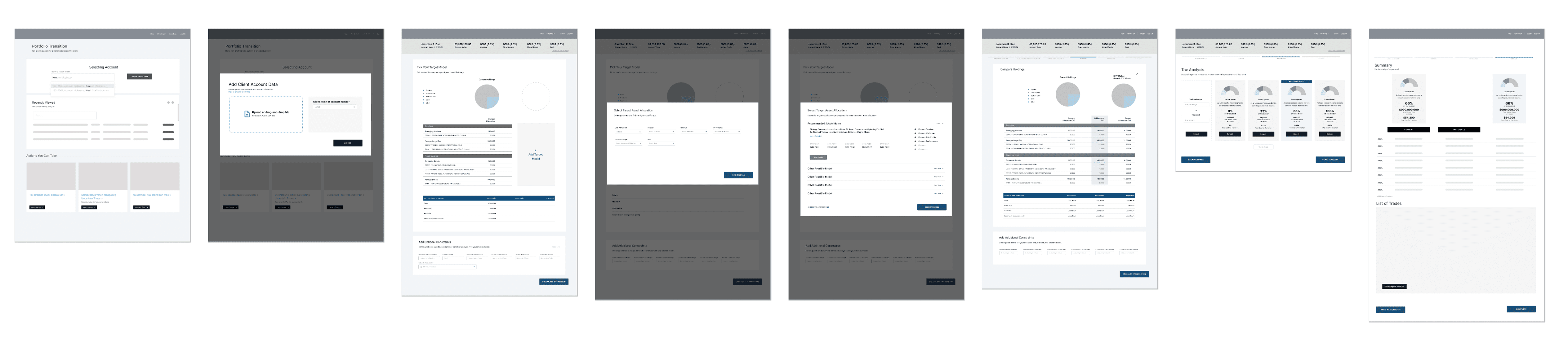
The process included user flows, wireframes, low-fidelity prototypes, two rounds of usability testing, and then a more refined Day 2 release prototype.
The prototype became a major decision-making tool. It helped the team test assumptions, refine copy, simplify interactions, and align on the changes that best balanced user needs with business priorities.
Usability Testing & Iteration
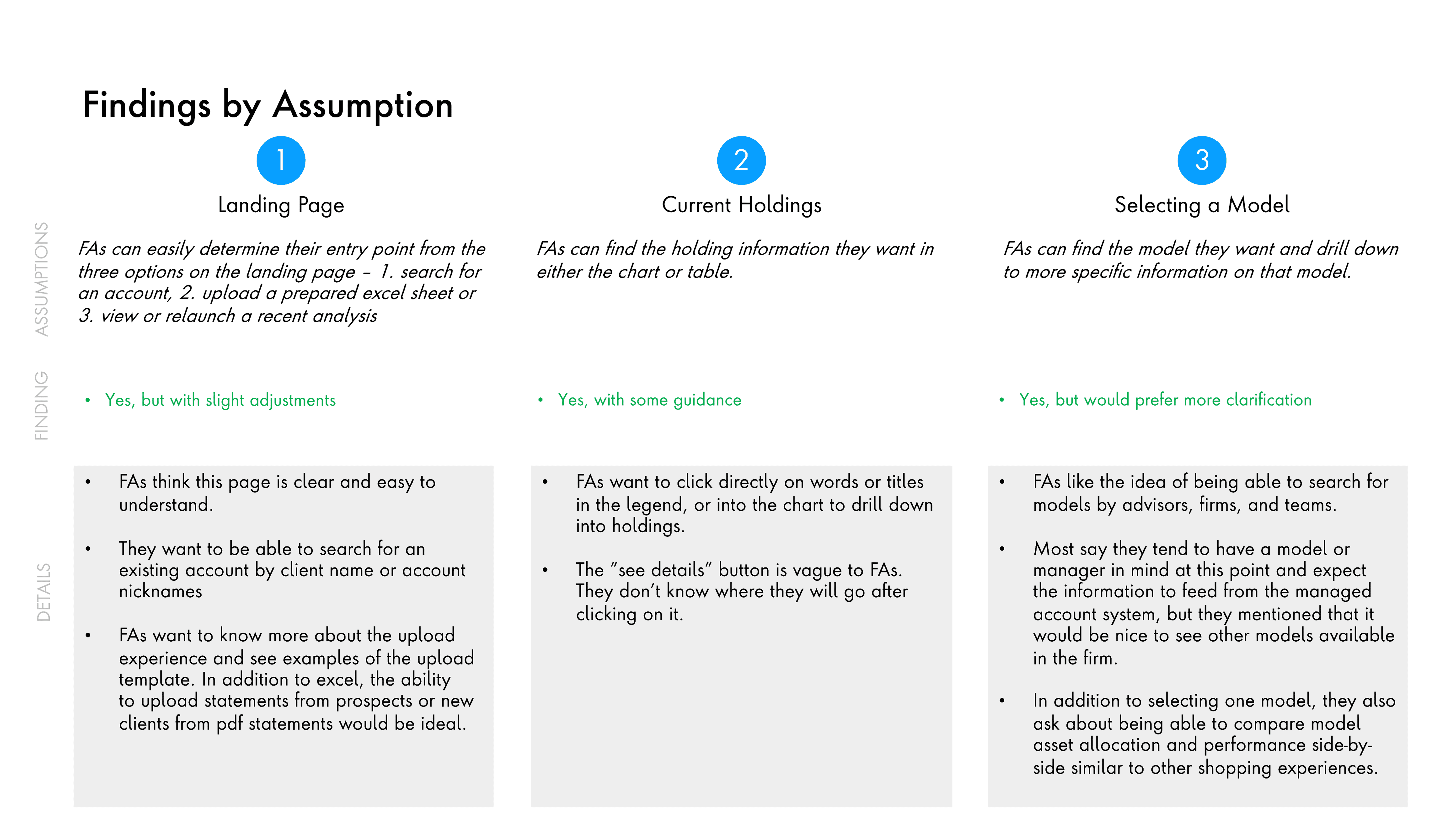
Round 2 testing helped us identify where the workflow was already working well and where more clarity, flexibility, and guidance were needed. The feedback below is organized by page and hotspot.
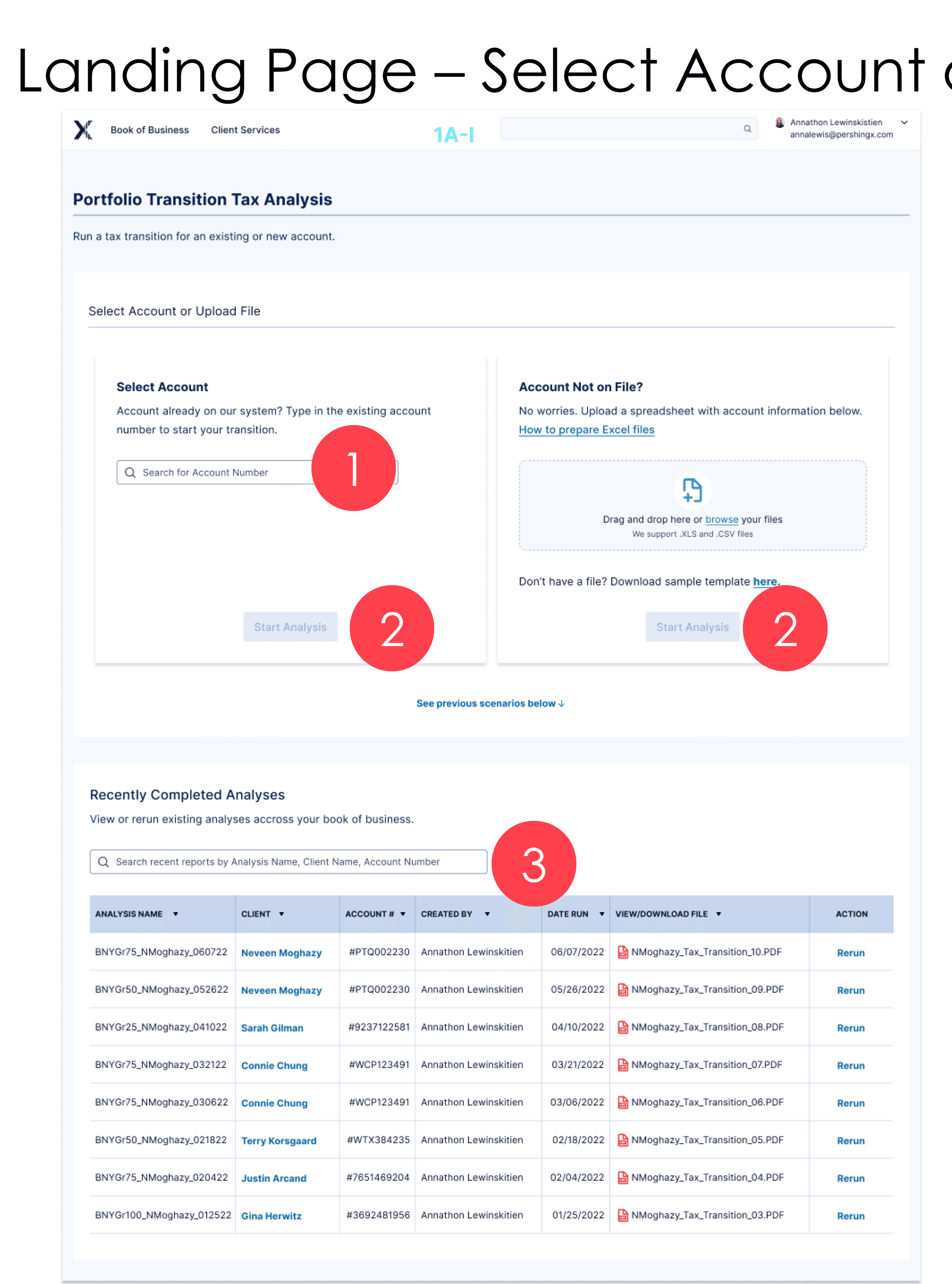
Hotspot 1
Problem: Advisors wanted a faster way to find accounts, including by client nickname or short name.
Solution: Prioritized more flexible account search.
Hotspot 2
Problem: Drag and drop tested well, but some advisors expected smarter upload behavior in the future, such as prefilling from statements.
Solution: Kept the upload pattern and noted smarter document import as a future opportunity.
Hotspot 3
Problem: Most advisors understood “Rerun,” but a few did not. They also wanted more control over past analyses.
Solution: Flagged “Rerun” for naming review and identified delete actions and added metadata like Rep ID as useful improvements.

Hotspot 1
Problem: Advisors found the legend clear, but wanted to click into each asset class from it.
Solution: Identified the legend as an opportunity for deeper interaction.
Hotspot 2
Problem: Advisors wanted the chart to feel more interactive and easier to interpret. Some were also unsure what “View Asset Allocation” would do.
Solution: Recommended better alignment between chart and legend, richer hover or click details, and clearer labeling for the asset allocation action.
Hotspot 3
Problem: Most advisors missed the progress bar and did not see it as actionable.
Solution: Recommended making progress more visible and potentially clickable.
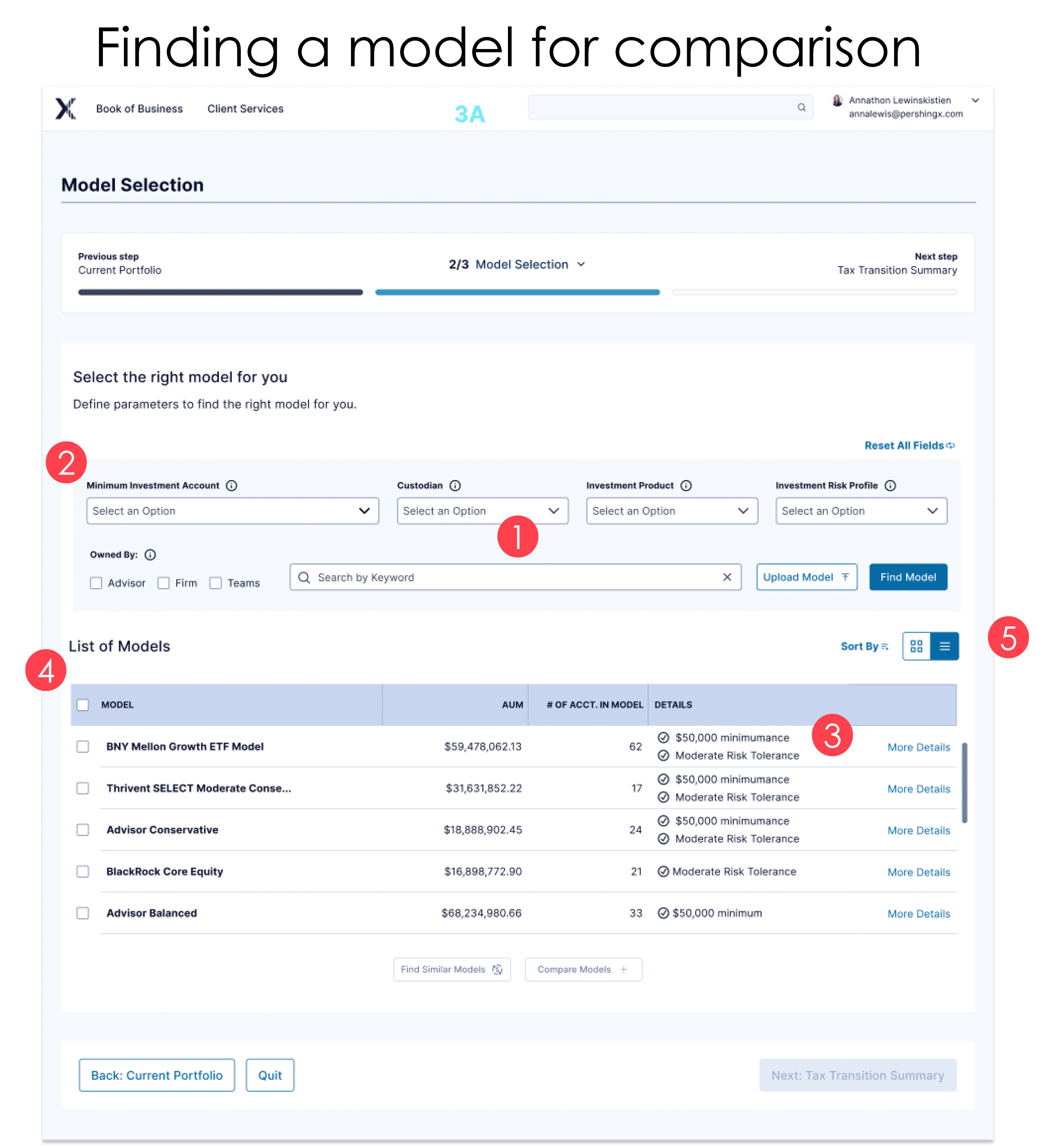
Hotspot 1
Problem: Advisors liked search, but “Upload Model” was unclear.
Solution: Identified the need for clearer labeling or supporting copy.
Hotspot 2
Problem: Advisors wanted a quicker way to return to models they use often.
Solution: Identified favorites or saved model lists as a future enhancement.
Hotspot 3
Problem: The model snapshot was helpful, but not strong enough to drive decisions on its own.
Solution: Treated it as supporting information and noted the need for stronger context.
Hotspot 4
Problem: Advisors generally understood how to select a model.
Solution: Kept this interaction largely unchanged.
Hotspot 5
Problem: Many advisors either missed the icons or guessed what they meant.
Solution: Recommended clearer affordances, labels, or tooltips.
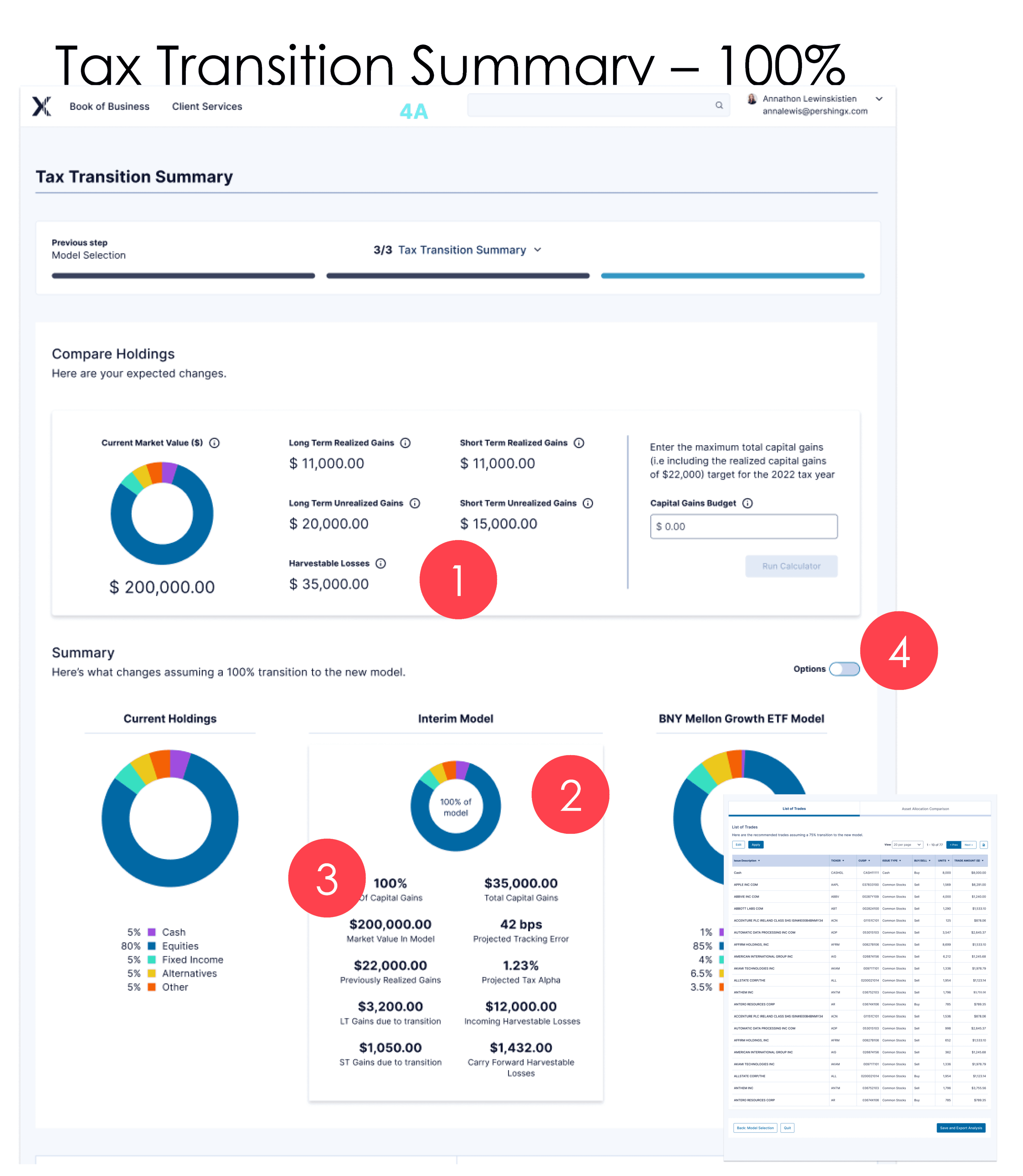
Hotspot 1
Problem: Advisors generally found this section clear enough.
Solution: Kept this area largely as is.
Hotspot 2
Problem: “Interim Model” was confusing and many advisors preferred the Options view first.
Solution: Identified the term and placement as key areas for revision.
Hotspot 3
Problem: Some advisors wanted to understand how calculations were derived.
Solution: Recommended stronger explanatory support.
Hotspot 4
Problem: The options functionality was not visible or understandable enough.
Solution: Recommended giving the options path more prominence.
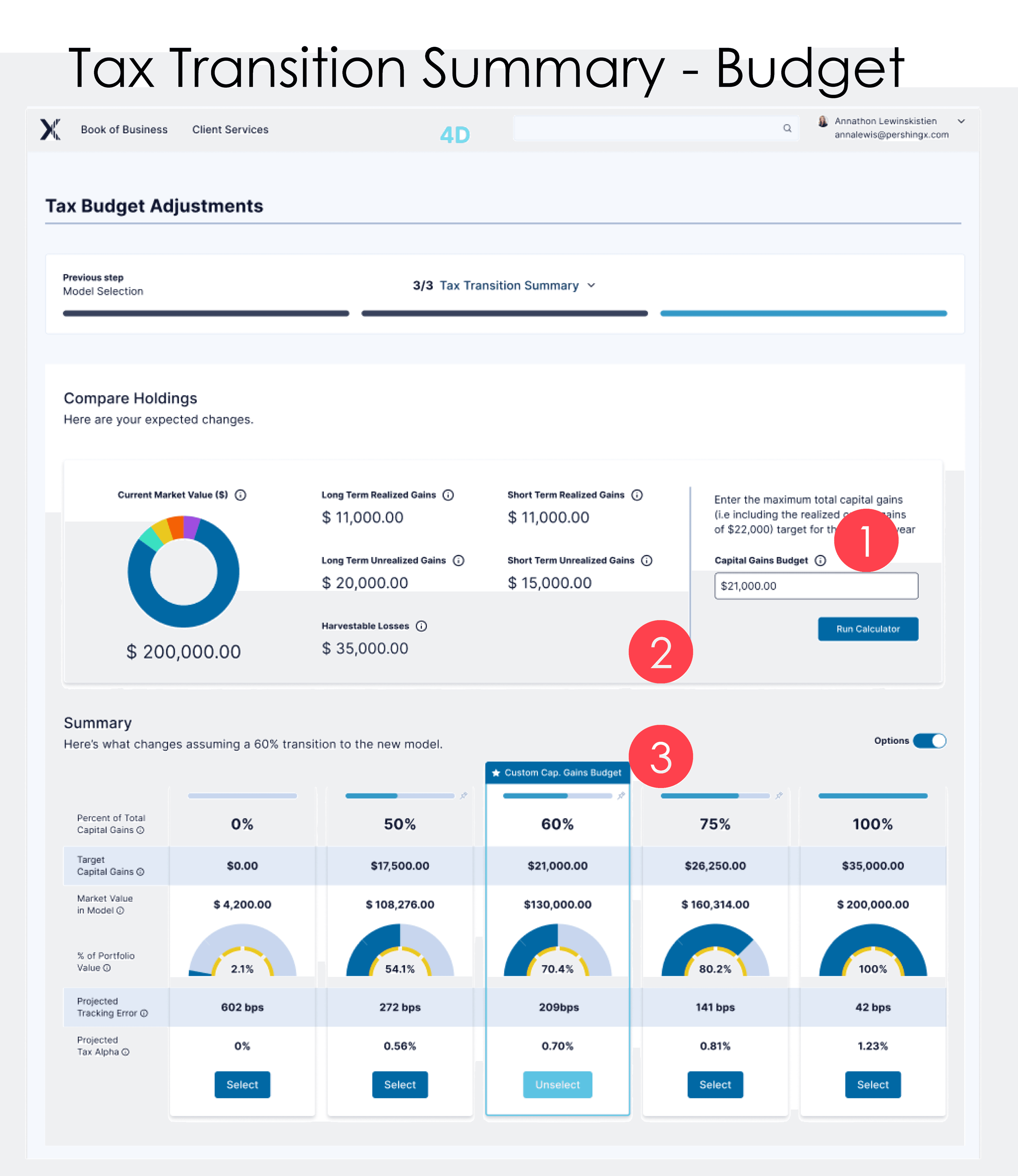
Hotspot 1
Problem: Some advisors missed this section or did not understand its purpose right away.
Solution: Identified a need for clearer framing and guidance.
Hotspot 2
Problem: Advisors liked the compare holdings data, but some found the column order confusing.
Solution: Flagged the table structure for refinement.
Hotspot 3
Problem: Advisors wanted more direct control over the capital gains budget and preferred this view over the 100% interim model view.
Solution: Identified more flexible budget controls and stronger prioritization of the options view as key improvements.
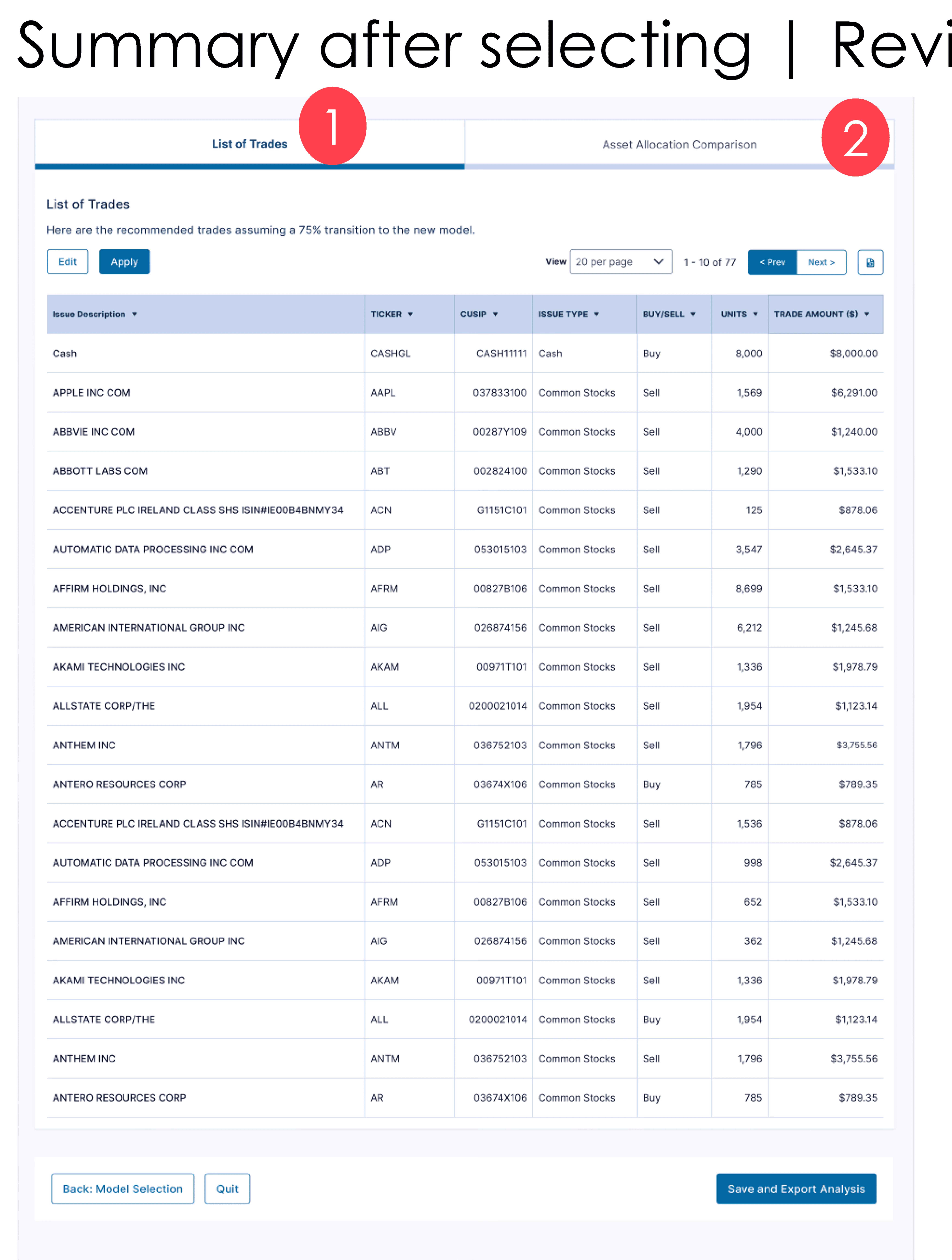
Hotspot 1
Problem: Advisors wanted more flexibility in the trades table, including editing, sorting, filtering, and richer financial detail.
Solution: Identified table customization and added trade context as important improvements.
Hotspot 2
Problem: Advisors wanted the supporting table to be more flexible and more informative.
Solution: Recommended stronger table controls and more financial detail.
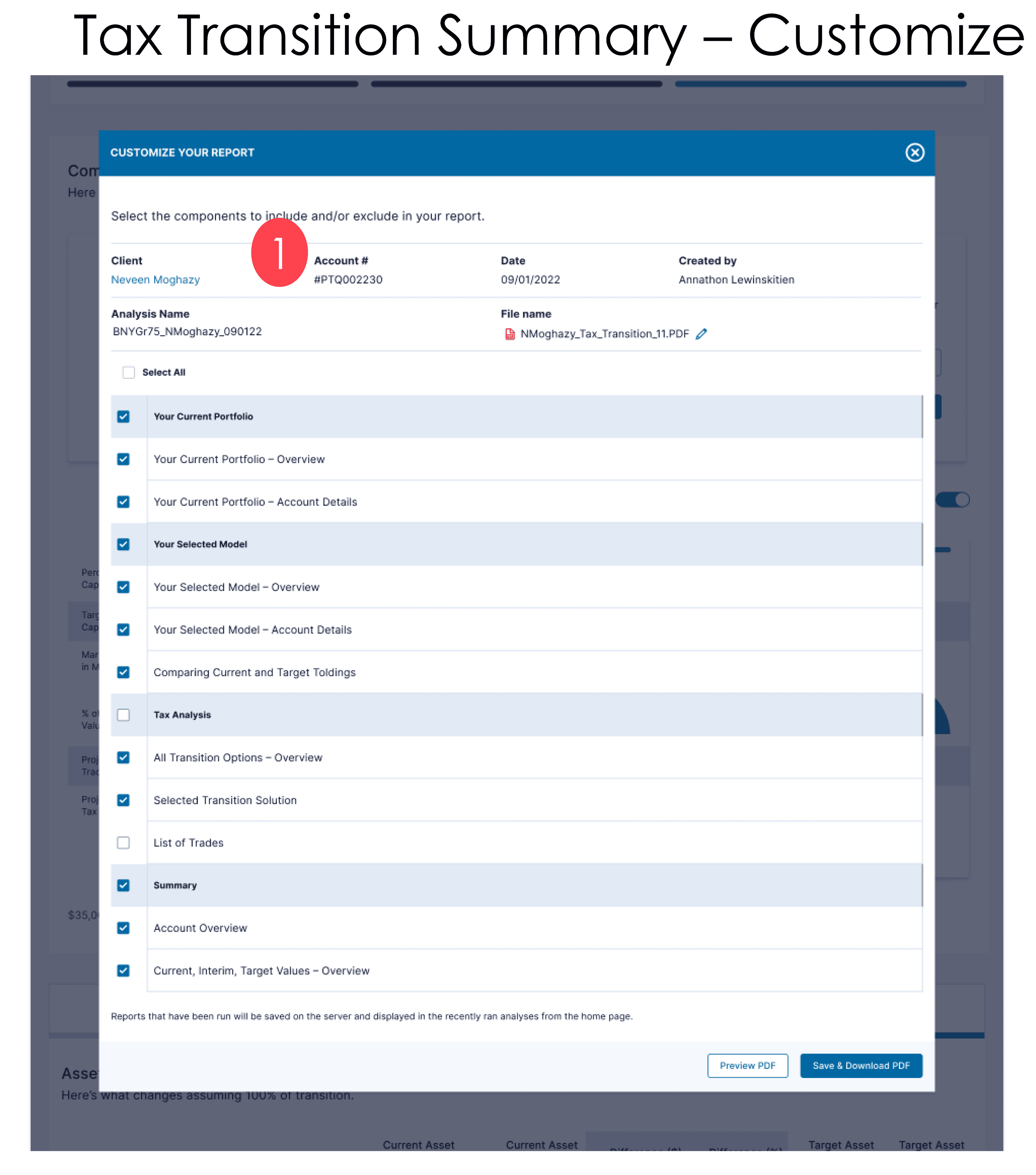
Hotspot 1
Problem: Most advisors understood they could rename the file and analysis, but not everyone noticed it immediately.
Solution: Kept the customization flow and noted a small opportunity to improve discoverability.
If you want, I can make these even tighter so they read more like polished portfolio copy instead of research notes.
Outcome & Impact
Overall, advisors saw Tax Transition as a strong value-add and a meaningful improvement over what many of them use today. The workflow was often described as clean, helpful, and easy to follow.
The research also made it clear that the product’s success would depend not only on the workflow itself, but on clarity, terminology, and interoperability. Those findings shaped the Day 2 release prototype and helped the team focus on the changes most likely to improve advisor confidence and usefulness.


Reflection & Learnings
Challenges
taking on broader responsibilities early due to leadership absence
coordinating across business, product, research, design, and engineering
designing around loading behavior and technical constraints
balancing ideal UX with business and implementation realities
What I Learned
product limitations are not always just design or engineering limitations
technical constraints need to be discussed early
in complex fintech tools, copy matters as much as layout
a polished interface is not enough if the workflow itself feels unfamiliar
even smaller research rounds can produce strong, actionable findings
Next Steps
continue optimizing the application for launch
finalize the Day 2 prototype with the latest usability updates
improve or replace the “Interim Model” concept
strengthen interoperability and transparency around data sources
expand the solution beyond the MVP to support multiple accounts and more complex scenarios
continue aligning design with product and engineering realities