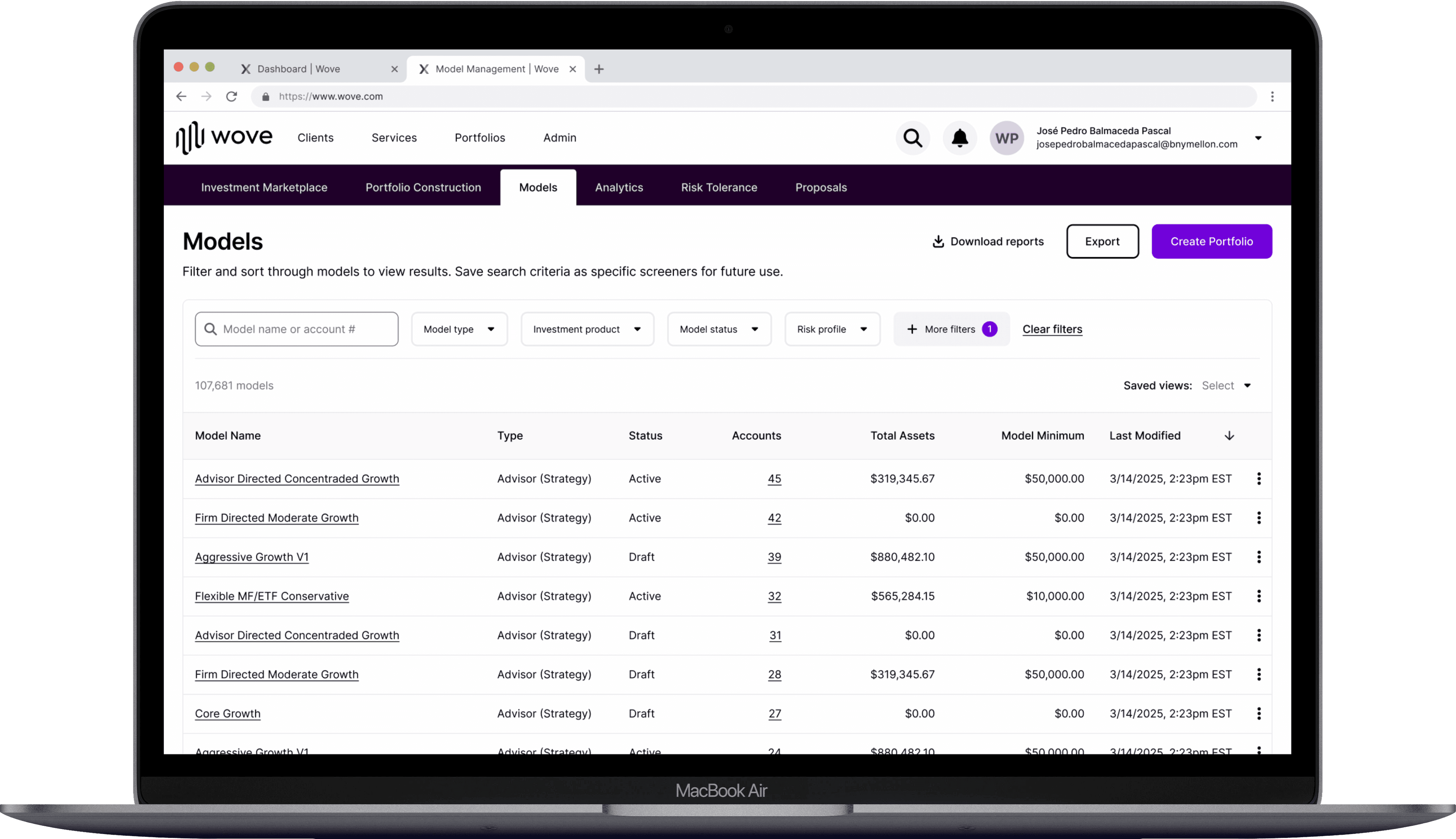
Model Management is Wove’s central workspace for viewing, filtering, organizing, and acting on models across advisors, multi-advisor users, and home office users.

//Role
Senior Product Designer
//Duration
2025 to present
//Context
BNY Mellon | Wove
//Industry
Fintech / Wealth Management
I worked on Model Management as part of the broader investment track I inherited after the prior consulting team rolled off. My focus was redesigning the model list experience, improving usability and performance, shaping features like Saved Views and security-based search, and helping position Model Management as the hub for related workflows like Investment Swaps and portfolio creation.
Problem & Opportunity
The Problem
Model Management is a high-frequency operational tool, but over time it became heavier and more fragmented. Users had to repeatedly rebuild the same filters, search did not reflect how they actually think about models, and performance became more important as more actions and workflows were added.
Because Wove is used by enterprise clients in real production environments, the product needed to be faster, clearer, and more scalable, not just visually cleaner.
The Opportunity
There was an opportunity to turn Model Management into a true operational hub by improving search, reducing repeated work, simplifying actions, and making related workflows easier to access from the place users already rely on every day.
Goals & Success Criteria
Streamline the model list experience across personas
Reduce repeated filtering work through Saved Views
Improve search with Ticker, CUSIP, and ISIN support
Improve time-to-action and support performance goals
Create clearer entry points for related workflows like Investment Swaps
Strengthen Model Management as the hub for model operations
Success was based on better efficiency, faster access to relevant models, stronger usability, and improved performance in a daily-use workflow.
Context & Constraints
This work lived inside an active enterprise product that receives ongoing feedback from real firms using Wove in production.
That meant the project had to balance redesign, re-architecture, stabilization, and client-driven enhancement at the same time. It was also deeply connected to adjacent workflows such as Portfolio Construction, linked accounts, exports, model details, and Investment Swaps.
This was not a one-time redesign. It was and still is an evolving product surface.

Users & Research
Target Users
Advisors
Multi-advisor users
Home office users
Internal support and operations teams tied to model workflows
Research Approach
This work appears to have been shaped more by continuous product feedback and active client usage than by one standalone research study. The direction came from recurring client needs, collaboration with product owners, regular refinement, and close engineering partnership around architecture, performance, and feasibility.
Key Insights
users often return to the same filtered lists, making Saved Views highly valuable
search needs to reflect underlying securities, not just model metadata
performance matters because this is a daily operational tool
related actions should live where users already manage models
smaller utility improvements can create outsized value in enterprise workflows
Problem Statement
How might we make Model Management fast, flexible, and scalable enough to support daily model operations across personas, while reducing friction around search, filtering, and related actions?
Strategy & Approach
The strategy was to treat Model Management as more than a grid.
The work focused on improving the list itself while also reducing repeated effort, expanding search, and creating better entry points for connected workflows. Performance and caching were part of the UX strategy, not separate from it.
The goal was to make Model Management feel like the operational center of the investment ecosystem.
Information Architecture & Flows

The experience centered around:
a consistent model list sorted by last modified
persona-aware filtering and access
Saved Views for recurring filter setups
search by model metadata and security identifiers
action menus for related workflows
exports and utilities across grid-based experiences
linked flows into details, overlays, accounts, and model actions
This direction also strengthened the relationship between Model Management and Portfolio Construction, with model creation moving toward more contextual launch points from within Model Management itself.
Investment Swaps also became a more intentional adjacent workflow, with clearer entry points, better visibility into progress, and a growing history layer.
Design System & Visual Direction
Like Portfolio Construction, this work was grounded in Hamilton, BNY Mellon’s design system.
That helped create consistency across repeated patterns like grids, filters, toolbars, overlays, drawers, empty states, and feedback states. Since I had also contributed to Hamilton, I was able to apply that systems thinking directly here.
The visual direction focused on:
clarity in dense, data-heavy views
faster scanning and lower cognitive load
reusable patterns for actions and utilities
consistency across personas and related flows

Wireframes to Prototype
This work evolved in phases rather than one clean cycle. It included the redesigned Model Management dashboard, Saved Views, search enhancements, export patterns, action entry points for Investment Swaps, swap history, and broader performance improvements.
The project moved into high-fidelity design, and for the more complex interactions I built a full prototype of the Model Management experience to validate page relationships, action flows, and end-to-end logic before development.
Because the product is active and client-facing, the process has stayed highly iterative.
Usability Testing & Iteration
This project has been shaped mainly through continuous product feedback, client needs, and ongoing refinement rather than one formal research package.
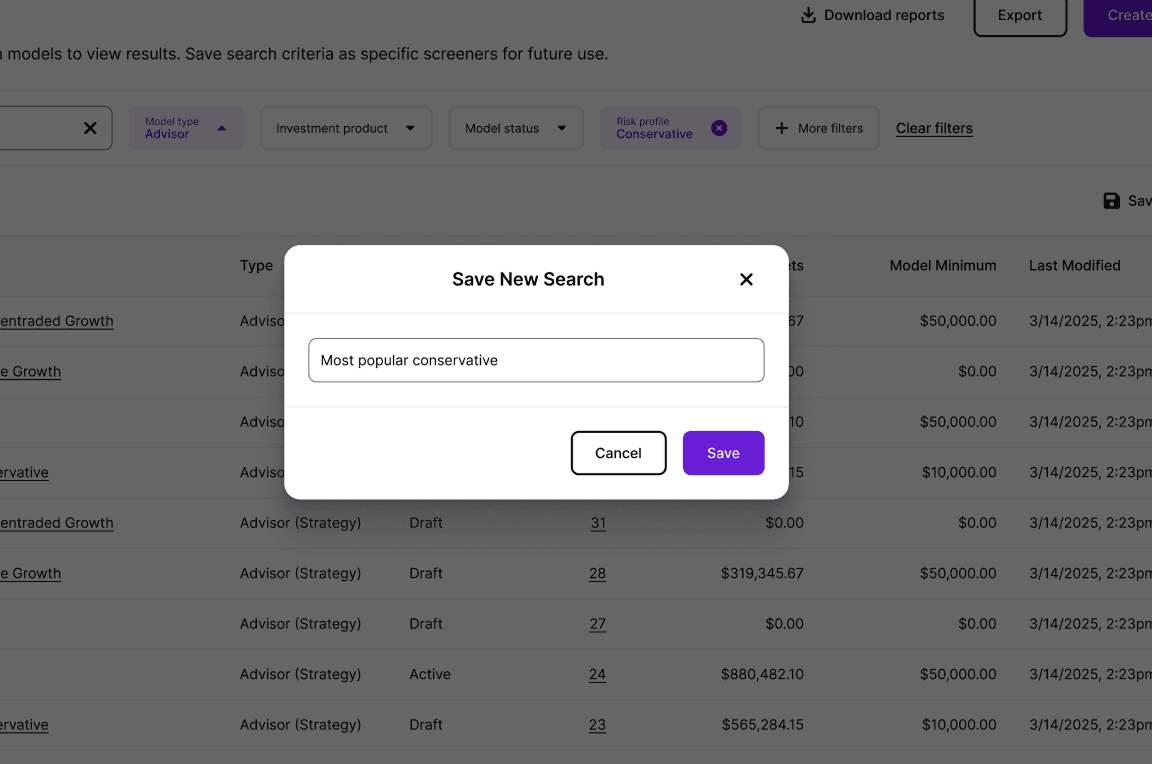
Problem: Users had to repeatedly rebuild the same filter setups
Solution: Introduced Saved Views so users could preserve and return to common working contexts
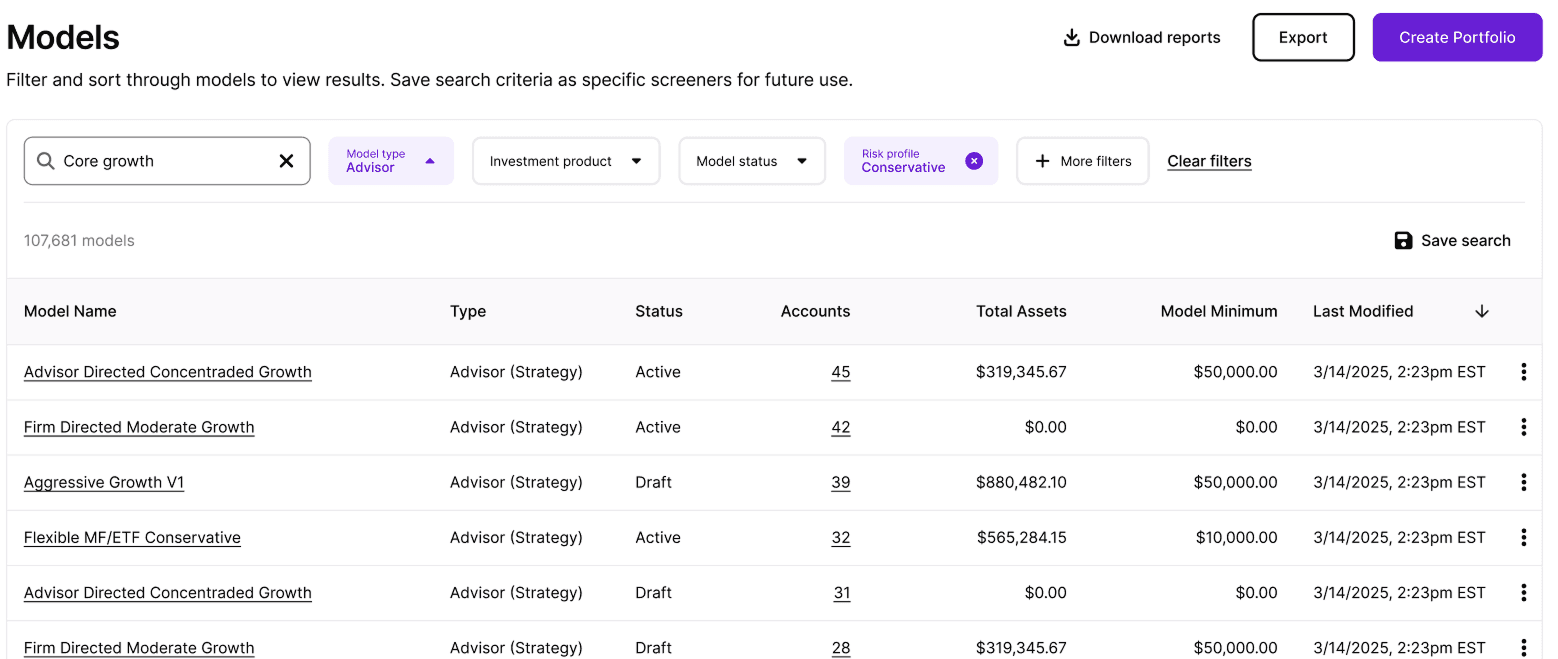
Problem: Search did not match how advisors think about models
Solution: Added support for Ticker, CUSIP, and ISIN search so users could find models based on the securities they contain
Problem: Performance matters deeply in a daily operational tool
Solution: Paired the UX redesign with caching and re-architecture efforts to support faster interaction
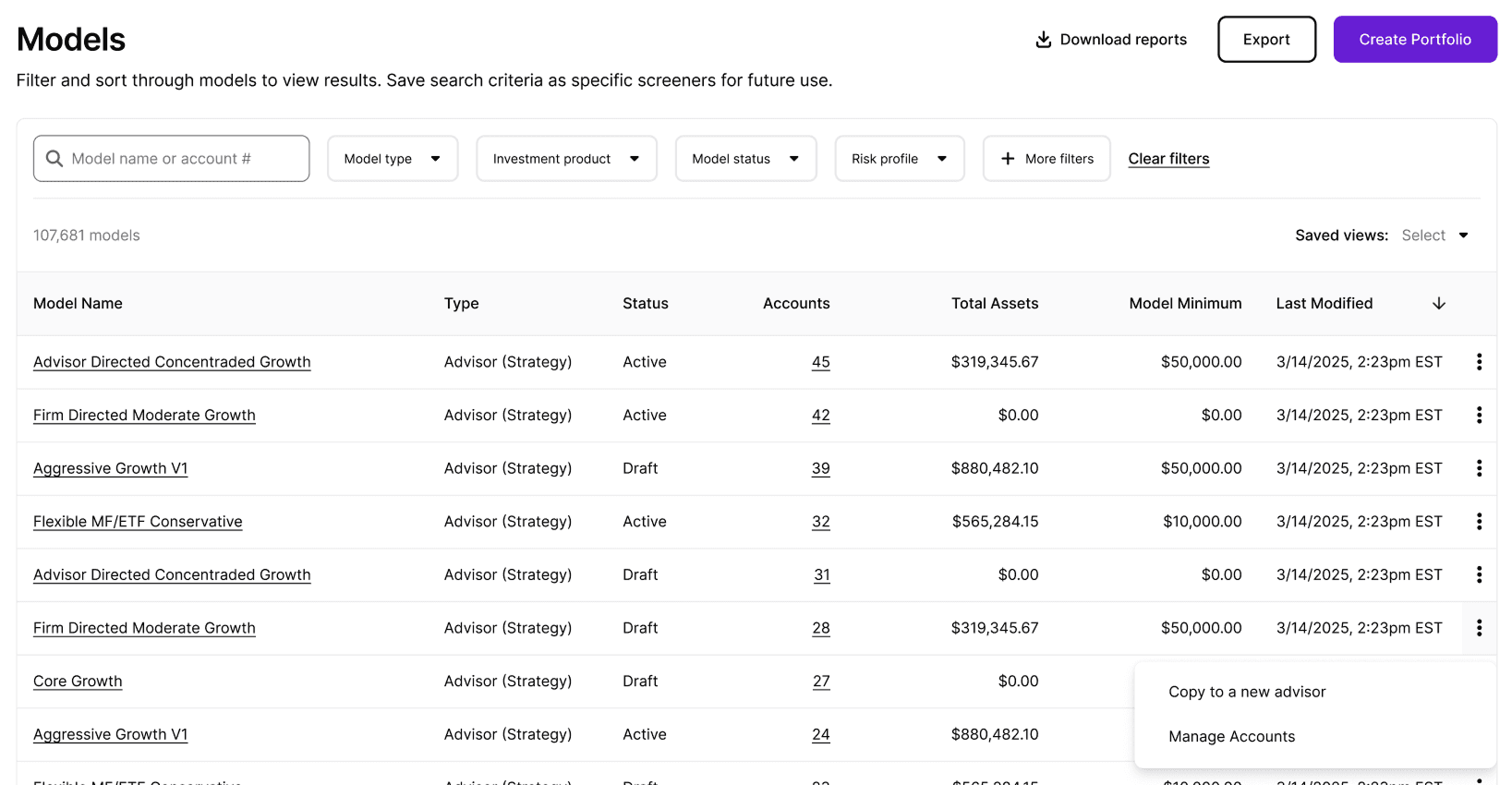
Problem: Related workflows were becoming harder to discover and manage
Solution: Positioned Model Management as the operational hub and introduced clearer action-based entry points
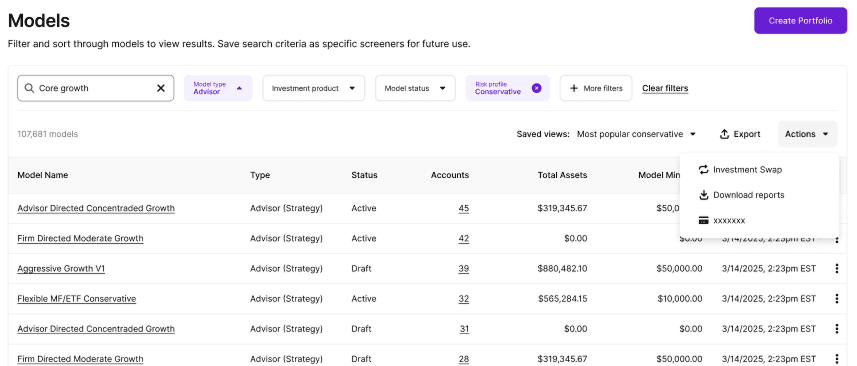
Problem: Investment Swaps needed better visibility and feedback
Solution: Kept swaps within the Action menu, expanded capabilities, added swap history, and improved processing visibility
Problem: Client-specific needs kept surfacing in everyday usage
Solution: Designed the product for ongoing iteration rather than as a fixed final state
Outcome & Impact
Model Management became a more intentional hub for model operations across the platform.
The work helped establish a more streamlined list experience, persistent Saved Views, more useful search behavior, clearer entry points for related workflows, and a stronger connection between usability and performance work.
It also supported the broader platform direction of making model management, portfolio creation, and model actions feel more cohesive instead of disconnected.


Reflection & Learnings
Challenges
designing for a live enterprise product while it kept evolving
balancing re-architecture, performance, and UX improvements at once
supporting multiple personas with different operational needs
keeping client requests from turning into product sprawl
building hub-like behavior without overwhelming the interface
What I Learned
repeated daily friction matters enormously in enterprise products
performance is part of the UX, especially in list-heavy tools
utility features like saved filters and exports can create major value
hub experiences need clear action patterns to stay understandable
client-driven products need systems thinking so iteration does not become inconsistency
Next Steps
continue refining Model Management as the hub for model operations
expand Saved Views and related personalization features
continue performance and architecture improvements
strengthen the connection between Model Management and Portfolio Construction
continue evolving Investment Swap support and history visibility
validate future iterations with more formal research where possible